.webp)




.svg)

.avif)
Every capability walked through one by one, with screenshots from real calls.
Key Takeaways (TL;DR)
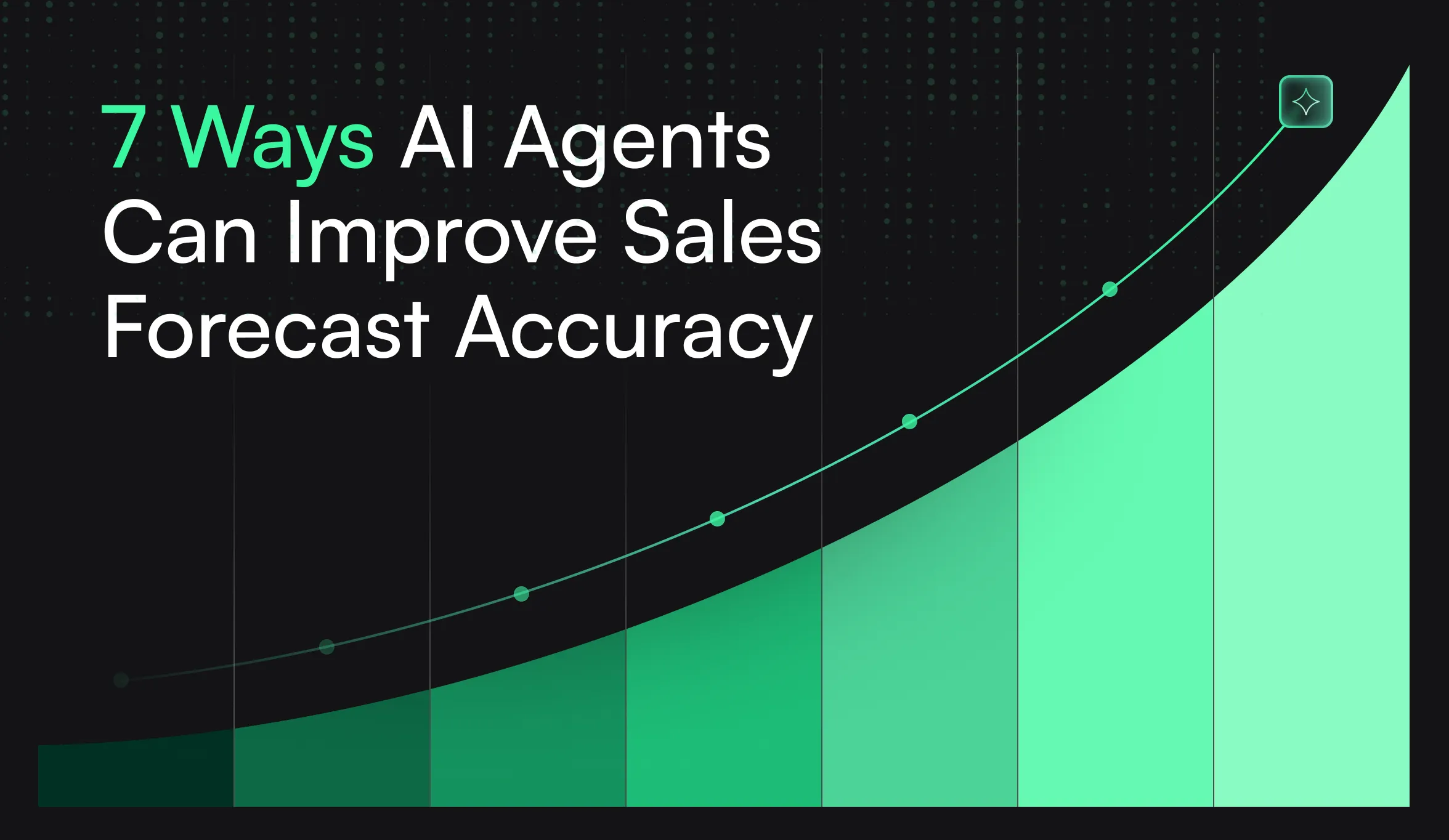
AI agents improve forecast accuracy by checking whether CRM data still matches real buyer activity.
- Flag stale or slipping deals earlier
- Reduce guesswork in commit calls
- Surface risk across emails, calls, and meetings
- Keep forecasts updated as deals change
- Support human judgment rather than replace it
Sales forecasting usually does not go wrong because someone used the wrong formula. It goes wrong because the number is built on information that is incomplete, subjective, or already old.
A close date changes and nobody asks why. A buyer goes quiet, but the opportunity stays in Commit. Legal takes ten days instead of three, yet the forecast still assumes the original timeline. The warning signs are there. They are simply scattered across calls, emails, calendars, and CRM fields, leaving teams without clear sales pipeline visibility.
That is where AI can make forecasting more reliable. Not by replacing judgment or producing a more confident-looking number, but by checking whether the evidence still supports the forecast. AI agents can follow CRM changes, buyer activity, conversations, and patterns from similar deals, then surface the moment a deal starts behaving differently from the story in the pipeline.
The seven examples below show where that helps, where it does not, and where a sales leader still needs to make the final call.
What AI agents actually change in a sales forecast
A forecast is only as reliable as the signals behind it. The problem is that those signals rarely live in one place.
The CRM shows the stage and close date. Email shows whether the buyer is still responding. Call recordings reveal objections, competitor mentions, and missing stakeholders. Calendar activity shows whether the deal is moving or quietly slowing down. A manager can piece this together for a few important opportunities, but not across an entire pipeline every day.
AI agents do that checking continuously. They compare what the rep has entered with what is actually happening across the deal. When those two stories stop matching, the agent surfaces the forecast risk before it turns into a quarter-end surprise.
That is different from a dashboard. A dashboard might show that a deal has not been updated in two weeks. An agent can connect that inactivity with a silent champion, a delayed security review, and a close date that has already moved twice, then flag the deal as a likely slip.
The agent does not make the final forecast call. It gives the rep and manager better evidence before they make it.
7 Ways AI Agents Make Forecasts More Accurate
1. Continuous Deal Scoring Based on Real Activity
Traditional deal scoring relies on stage, close date, and deal size. AI agents score deals based on engagement patterns: email response rates, meeting frequency, stakeholder involvement, and content consumption. A deal in Stage 4 with zero buyer activity in two weeks gets flagged. A deal in Stage 2 with a VP joining calls gets elevated.
I've watched teams adopt activity-based scoring and see their forecast variance drop within one quarter. The signal was always there. They just didn't have a way to aggregate it in real time.
2. Eliminating Stale Pipeline Automatically
Dead deals can sit in pipelines for months. They inflate coverage ratios and distort the forecast.
AI agents identify opportunities that have gone cold by looking at interaction decay, missed next steps, repeated close-date changes, and long gaps in buyer activity. They can then flag those deals for review, removal, or re-engagement.
Not every quiet deal is dead, especially in longer enterprise sales cycles. But surfacing the inactivity gives managers a reason to challenge whether the opportunity still has a realistic path to close..
3. Multi-Signal Risk Detection
An AI agent doesn't just look at one metric. It correlates signals across communication channels, CRM updates, and buyer behavior to surface risk early. A champion goes silent. A competitor gets mentioned on a call. The legal review that usually takes three days is now on day ten. Each signal alone might not alarm anyone. Together, they tell a story.
This compound risk detection is something no rep or manager can do manually across 50+ deals.
4. Reducing Rep Subjectivity in Commit Calls
Reps commit based on feel. AI agents commit based on data. When an agent provides a probability score rooted in historical win patterns and current deal behavior, the commit conversation changes. It becomes a debate about evidence, not gut instinct.
I've found that when reps see their own subjective probability next to the agent's data-driven probability, they self-correct. The gap between the two numbers is where coaching happens.
5. Historical Pattern Matching for Deal Velocity
AI agents analyze how similar deals have progressed historically: same industry, same deal size, same buying committee structure. They predict whether a deal is ahead of or behind its expected pace. This gives managers a velocity lens on the forecast that's impossible to build manually.
Monday.com highlights this as one of the highest-impact applications: using AI to compare current deals against historical cohorts to predict close timing with far greater precision.
6. Automated Forecast Roll-Ups with Confidence Intervals
Instead of a single number, AI agents produce forecasts with confidence ranges. "We're 70% likely to land between $4.2M and $4.8M" is more useful than "$4.5M committed." It gives finance and operations a range to plan around, and it surfaces how much uncertainty exists in the current pipeline.
This is where I see the biggest mindset shift for sales leaders. Moving from a single number to a probability distribution feels uncomfortable at first. But it's honest. And honesty in forecasting is what lets the rest of the business plan effectively.
7. Real-Time Forecast Adjustment
Forecasts traditionally update weekly. AI agents update continuously. A deal slips, the forecast adjusts. A new opportunity accelerates, the forecast reflects it. This means leadership sees the forecast as a living number, not a snapshot from Monday morning's pipeline review.
Real-time adjustment also reduces end-of-quarter surprises. By the time you're in the last two weeks, the agent has already flagged the deals that are at risk of slipping and the ones likely to pull in.
How to Implement AI Agents Without Wrecking Your Stack
The biggest mistake I see teams make is treating AI agent deployment as a rip-and-replace project. It isn't. Start with data integration. Make sure your CRM, email, and call data are accessible. Then layer in one agent capability at a time: deal scoring first, then risk detection, then forecast roll-ups.
One Reddit thread from someone who builds AI agents professionally put it well: the mess in AI agent implementation comes from trying to do everything at once without clean data foundations. Start narrow. Prove value. Expand.
Your existing tools don't need to go away. The agent sits on top of them, reading signals and surfacing insights.
Real Results: What Accurate Forecasting Unlocks
Forecast accuracy isn't a vanity metric. It drives resource allocation, hiring plans, inventory decisions, and board confidence. When your forecast is within 5% of actual, finance trusts the number. When finance trusts the number, the business moves faster.
I've seen accurate forecasting directly reduce quarter-end discounting because leadership stopped panicking at week 10. That alone pays for the technology.
Common Objections and How to Handle Them
"Our reps won't trust it." They don't have to trust it immediately. Run the agent alongside your existing process for one quarter. Let reps compare their calls to the agent's calls. The data speaks for itself.
"Our data isn't clean enough." No one's data is perfectly clean. AI agents are designed to work with imperfect data and improve over time. Waiting for perfect data means waiting forever.
"We already have BI dashboards." Dashboards report. Agents act. A dashboard tells you a deal hasn't been updated. An agent tells you why it's at risk based on twelve different signals.
What to Do Next
Map your current forecast process and identify where subjectivity enters the pipeline. That's your starting point for AI agent adoption. If you want to see how AI agents work inside a real sales workflow, book a demo with MaxIQ and test it against your own pipeline data. Start with one quarter. Measure the variance. Then decide.
.png)
.webp)